
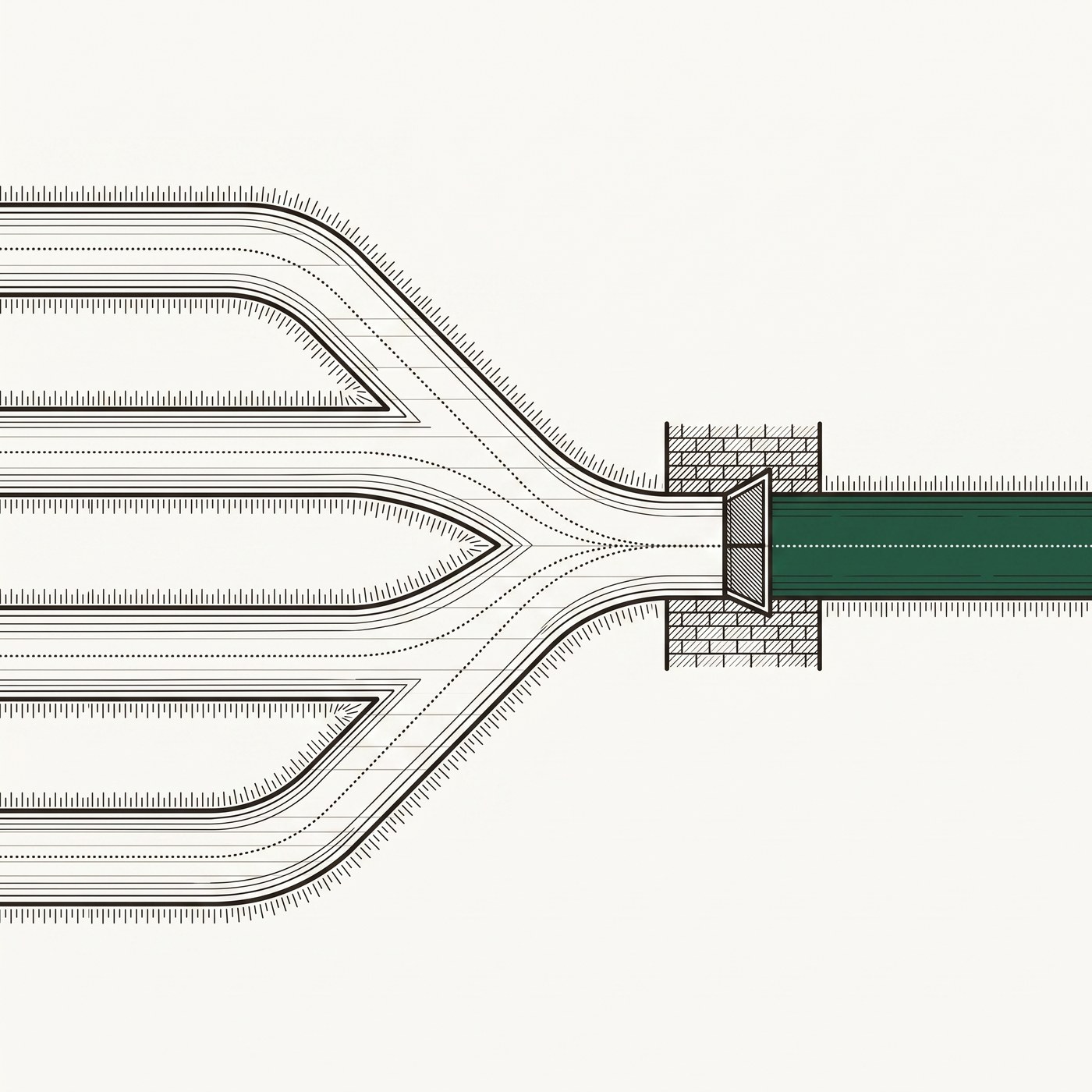
The AI question reaches a fund this size in fragments. A statistic that says nearly everything fails, and another that says nearly everything works. An operating-partner hire that gets discussed every budget season and never made. A company presenting AI wins at the quarterly that the board receives politely and privately discounts. A playbook pitch promising that one win will scale across the portfolio, from a vendor who has never read the portfolio. Each fragment gets its own meeting and its own quiet deferral to next quarter.
I have argued in these pages that each fragment has an answer. This piece makes a different claim: they are not four problems. They are four views of one system, and the system fits in a paragraph.
The value of AI in a portfolio is decided before anything launches – at a front gate, in the selection of which company, which use case, which way, and whether at all. A gate needs an owner, and this bracket cannot hire the one the industry invented, so the seat gets retained in its advisory form instead. The owner’s readings are worth exactly as much as his freedom to say no – independence is not a virtue here, it is an operating condition. And what passes the gate compounds, because a portfolio, unlike a standalone company, can run a proven play again. That is the whole thesis. The rest of this piece walks it, one station at a time, and each station links to the full argument – a compressed case should say where its evidence lives.
One thing declared before the walk: I sell the seat this argument ends in. That is exactly why every claim the argument rests on comes from a named source you can check without me – and where a number does not survive checking at face value, I say so.
The funnel: the game is played before launch
Start with the two statistics that appear to cancel each other out. The headline you have seen – “95 percent of AI pilots fail” – is the popular press’s paraphrase of a 2025 MIT study, a small early study its own authors call preliminary. What it reported: 95 percent of organizations getting zero return from generative AI, graded on a six-month window the authors themselves concede may understate success. The counter-number circulates in private equity reading piles: in FTI Consulting’s 2026 survey – whose sample starts at $1 billion in fund assets, a notch above much of this bracket – 95 percent of funds with AI programs in production report initiatives at or above their business case. The survivors, grading the survivors, against targets they set themselves.
Neither number survives diligence at face value. Both directions do. They are two ends of one funnel: most of what enters dies before production, and most of what reaches production pays. The deaths trace to how initiatives meet the organization – tool licenses handed out with nothing reorganized around how the work gets done, which BCG’s piece on private equity names Deploy without Reshape – not to the people who ran them. Put the two ends together and the conclusion is awkward for anyone selling tools: the outcome is mostly settled before launch, in the selection. The full argument takes both reports apart against their own fine print; the short version is that selection is the work.
The gate: who owns the selection
A funnel is only a diagram until someone owns its front gate. The industry has already named the owner – Korn Ferry named the “AI operating partner” in early 2025, and Heidrick & Struggles wrote the candidate spec: scarce, senior, expecting carry and portfolio-wide scope. The trouble is arithmetic. A fund between $250 million and $2 billion runs its entire firm on the management fee – roughly two percent of committed capital, call it $5 to $20 million a year – and the portfolio the seat would amortize across is eight to fifteen companies, not eighty. By my count the hire does not pencil until the portfolio runs well north of a dozen companies – and most of this bracket sits below that line.
Run it against your own fee stream before taking my word for it.
And at the many funds this size with no operating partner at all, it never even runs as a hiring question – the mandate lands on the deal partner herself, one more claim on the boards she chairs and the deals she is paid to find.
The same industry answered its own objection in the same breath. Korn Ferry’s words: AI operating partners “can be full-time employees or part-time advisors.” So the question was never whether to fill the seat; it is which form of it to retain – and retaining judgment is something this business already does without embarrassment, for counsel and for quality-of-earnings work. The full argument runs the hiring math and sets out three tests for buying the advisory form well. The compressed version is a sentence: retain the judgment; keep the capability.
The read: why the gate must be independent
A gate has a second failure mode, quieter than the first: readings nobody believes. AlixPartners’ most recent leadership survey – one of the few whose sample reaches well into this bracket – found company leaders more than twice as likely as their investors to say they are satisfied with the same AI results. That gap is expensive in both chairs. The sponsor cannot answer an LP’s diligence questionnaire with numbers it privately discounts, and cannot translate a play it does not believe in. The company is paying a discount on wins that are often real – progress its team produced that builds no equity story because no one upstairs can verify it. Insistence is not evidence.
What closes the gap is a reader who is free – structurally, not rhetorically – to conclude “not here, not yet”: no one whose paycheck needs the answer to be yes, and a method small enough for an investment committee to check in one sitting. And the part the fund side usually gets wrong: that independence is not a check on the companies. It cuts the other way just as hard – an independent read is what makes a company’s true wins bankable, in the board deck, in front of the IC, in the DDQ answer, at exit. The full argument sits in both chairs properly. Verification, done right, is the mechanism by which real progress finally gets paid.
The multiplier: why what passes the gate compounds
If the gate were the whole story, AI would be a company-level question and a fund would be the wrong altitude for it. What happens after the gate is why it is not. A standalone company that gets AI right has a win; a fund that gets one company right holds a play it can run again, because the structure for running it again – board control, a common governance rhythm, eight or more companies able to take an adapted version – is the structure a buyout fund already has. BCG’s prescription to private equity is precisely this motion: prove the play at one company, then run adapted versions across the rest.
Their piece is an argument rather than a survey – worth knowing before you quote it onward.
Honest translation is rarer than the pitch deck version, and the difference is a map – a written account of where the proven play does not travel, and why. Without the map, a translation is just a rollout. It also runs on ownership rules applied to every company the same way: the first company keeps its win and its credit; every receiving company gets its own version, with the same protections; what travels is the pattern, never a company’s data; and no company is graded against another. Rules like these are not courtesy – they are where the second and third real wins come from. Someone has to carry all this between companies, and the candidates fail one by one: the first team has a business to run, local consultants accumulate no portfolio memory, and the partners’ calendars are the fund’s scarcest resource. The carrier needs portfolio-level standing and company-level trust at once – which is the advisory seat again, and the strongest argument for it: neither a single company’s hire nor company-by-company consultants can carry a play between companies. The full argument works through the map, the rules, and the carrier.
Where the pieces sit
Assembled, the four stations settle a question that sounds administrative and is not: where does everything live? The judgment sits at fund altitude, because the funnel, the gate, and the map are portfolio objects – and it can enter the portfolio free, as a baseline read. The work lives at the company it serves: owned there, run by its team, and – as is the norm for post-close operational work – engaged and paid for there, which is part of what owning a win means. As for how the seat itself is retained, there are two workable doors – a fund can retain the advisory form across its portfolio, and companies can engage the work directly on their own paper – and I am deliberately not closing either. That choice belongs to the fund and its companies, not to an article.
My conviction about this motion is firsthand, from the receiving end rather than the selling end: I spent years as VP of analytics inside a roughly $1.5B PE-owned telecom, brought in through the sponsor’s operating partner, for work the leadership had asked for and could not staff from inside. Help that arrives at the company’s request and leaves capability behind is the version of all this a management team is glad to see walk in.
The fragments, reassembled
Go back to the opening list. The contradictory statistics were one funnel read from its two ends. The hire that never gets made was a question of form, not of whether. The politely doubted board wins were a missing instrument, not a dishonest company. The playbook pitch that smelled wrong was a translation attempted without a map. Read separately, each fragment invites another quarter of deferral; read as one system, they specify a first step small enough to take this quarter – run the gate once, across the whole portfolio, and see what it says. The step is deliberately the smallest piece of the system, and the system is what makes it worth taking.
That first step is The Portfolio AI Baseline: the funnel’s front gate, applied to every company you hold – which of them could support real AI work in the next few quarters, which way, and which should wait. It costs the partner under three hours – a working session and a playback, with the data request handled by an analyst on your team and the desk work happening off your calendar. It is free for a stated reason: the baseline is how I choose the work, and I make money only if the fund decides to continue past it – which is why it is allowed to conclude that you should not.